Glen helps Genzon club prepare for its first Volvo China Open
Scottish golf architect Niall Glen is working with Genzon Golf Club in Shenzhen to prepare the club’s course for the Volvo China Open in April.
The Genzon course was designed by Neil Haworth and underwent an extensive renovation in 2008. It was the first course in Asia to use Platinum paspalum grass, supplied by Atlas Turf. Now, Glen is helping the club formulate a landscape strategy, not only for the tournament but also for the longer term.
“The playing surfaces are already virtually ready for the tournament, but the view corridors from many of the championship tees, particularly on the front nine holes, are very narrow. Tree and foliage clearance is required to ensure the playability of these holes,” Glen told GCA. “Vast swathes of internal tree copses have become overgrown and we are now in the process of pruning to lift the canopy to a minimum of three metres above ground level. This will allow the undergrowth to be maintained properly for the first time in many years. Ultimately this gives the course a cleaner look as well as a much greater sense of space.”
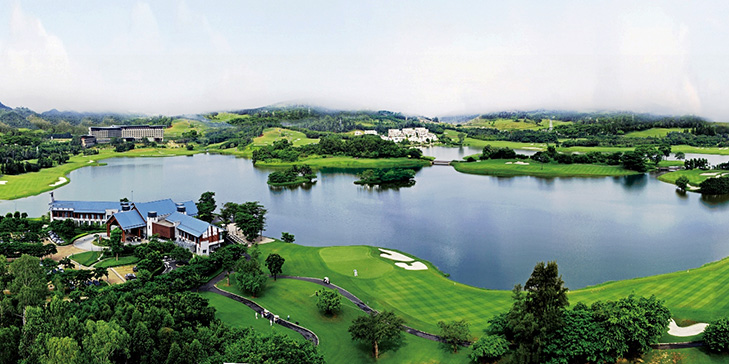
“The second stage of the landscaping strategy is aimed at helping the club to showcase the course in its best light for the tournament, and thereafter for the members, by adding colour to an otherwise green backdrop,” Glen added. “The vision is to create a landscape framework akin to that of Augusta National, with large mature trees framing each hole and flowering plants and shrubs providing a much needed burst of colour closer to ground level. In China there is a desire for each course to be completely distinctive. On new designs, this is usually achieved through clever architectural design, but it is possibly more challenging to create a unique aesthetic background for courses due to prevalent topographic and climatic factors. This might be the first time that an existing course in China has tried to completely alter the aesthetic character of the course without altering any of the actual playing surfaces.”